Monday, December 31, 2012
Guns and Freedom: An American Conundrum
I didn’t grow up with guns. I have never owned a gun. In fact, as a child and young adult in Great Britain, I never even saw a gun - except on television.
The United States is very different to Great Britain. It has different freedoms and a unique history that has given birth to those freedoms. Because of this, threats to take away people’s guns by force would go nowhere. Nor would it solve the issue of gun violence. Criminals will always get guns – legal or not.
In the aftermath of the murder of 20 six and seven year-olds, as well as six adults, at a Connecticut school, there has never been a more critical time for serious debate about guns. The National Rifle Association’s claim that the reason for mass school shootings is not the prevalence of military-style weapons but the lack of armed officers in schools left me cold. This misses the point entirely. It also assumes that living in an armed society is normal. It isn’t.
Even though I’m not a citizen, I have lived here as a legal resident for two decades and support the right to bear arms. But I would suggest some common sense restrictions, especially with regard to military-style assault weapons that release a round of bullets with one pull of the trigger.
The NRA has easy answers. Gun control advocates have easy answers. But the answers are not easy. The issue is far from simple, and changing the law is not going to make guns disappear from the black market. What is needed is dialogue, not unilateral dictates. Those children cannot have died in vain. After each of the recent massacres there has been excuses and inaction; now is the time for action.
Armed guards wouldn’t make classrooms safer, let alone promote a learning environment. There would have to be guards in every classroom and not just at the entrances as there are many ways to get into a school. A student simply has to put a gun in a bag, come to school as normal and start shooting, and there will be multiple deaths before an armed guard could get there. Schools should be safe sanctuaries, not armed camps.
So, what to do? For a start, severely restrict or ban the relative easy access to military style assault weapons, whose purpose is to kill human beings. Close the loopholes that allow guns to be sold without background checks, and have a mandatory training course for all guns purchased.
Consider the issue of mental illness and alienation in society. Most—if not all--of the recent perpetrators of mass shootings seemed to be mentally ill. Beef up the background checks for mental illness. And buying guns and ammo on the internet just seems like a really bad idea.
A recent no-questions-asked gun buyback program in Los Angeles was a huge success. Expand this to other towns and cities. Fewer guns on the streets can only be a good thing.
Today children are bombarded with violence throughout the gaming industry, movies, and the media. Where is the outrage about the ever increasing violence in video games?
In a free society there has to be reason and I hope there will be a shift in the conversation. America is better than this. What next? Kids going to school wearing bullet proof vests?
Friday, October 19, 2012
Why Malala Matters
Malala Yousafzai, aged 15, was shot in the head by a Taliban gunman as she returned home from school in Pakistan’s Swat Valley. Her alleged offense? A yearning for an education and her public pronouncements in pursuit of it.
Even as she recovers, after being flown to a hospital in Great Britain, the Taliban chillingly re-stated their intent to kill her - should she survive.
Fundamentalism is unbending and the Taliban’s obscurantist interpretation of Islam has nothing to do with religion. Scratch at the surface of this and many other authoritarian creeds and you’ll see a play for power and control. Imposing your will by force.
Malala, with her books and outspoken denunciation of school closings, threatened that; the alternative is to be a second class citizen.
A fundamentalist may claim that theirs is the path to true salvation, but how can faith be real and true if coerced? It is knowledge they fear. And it is knowledge that will set you free.
The enduring menace of the Taliban will have consequences for girls and women long into the future though perhaps this brave girl’s actions will a more enduring impact; after all, the Taliban targeted her because they fear the future that she embodies.
Three years ago she spoke out, in turn giving voice to thousands of girls like her – banned from attending school and hidden from public view. Her courage in facing down the Taliban is a sign they cannot win because without tolerance and education there is no future.
I hope Malala will inspire a new generation. The future lies in protecting children like her -- and there are millions of them.
Sunday, June 10, 2012
Flame Fever Grips Britain

The London Olympics--for so long a glimmer on the horizon--are now just weeks away.
Last month, while staying with my dad, I saw the Olympic flame pass through Cirencester. Before it arrived on British soil I had images of lone runners splashing through puddles, watched by only hardy enthusiasts. The reality could not have been more different. A torch relay that began in uncertainty quickly became a phenomenon.
In Cirencester, the local schools closed early and the town center was filled with thousands of people. Long before the flame arrived they stood in lines six deep waving union jacks and school children clutched replica cardboard torches, creating a carnival atmosphere. The sense of anticipation was palpable.
In spite of the corporate sponsors’ choreographed efforts, the relay quickly took on a life of its own and became the people’s event. The same thing has happened in towns and villages across Britain. The triumph has been to make the London Games seem both national and local.
But not everyone is excited about the Olympics. Many people argue that the two weeks spent staging the Games is a misuse of tax payers’ money, and that the cost, £9 billion ($13.8 billion),--a huge increase on the original claimed cost of £2.3 billion ($3.5 billion)--could have been better spent on education or the health service.
Olympic history is also littered with white elephants and debt. When the Games are over, it will be the Government left holding the bag and the British taxpayer who will be paying for it for years to come. The government is confident there will be a lasting legacy of regeneration, at least in east London. We’ll see.
Despite the enormous cost, hosting the Olympics is a once in a lifetime opportunity and I can‘t wait for the Opening Ceremony. In any event, Britain always rises to the grand occasion. Case in point: The Diamond Jubilee celebrations. And we certainly have the heritage. Just look at some of the Olympic venues: cycling at Hampden Court Palace; beach volleyball at Horse Guards’ Parade; road running in the Mall; and tennis at Wimbledon. Not bad for starters.
A serious failure, however, is the Games’ dog’s dinner of an official logo. In an apparent modern twist on the Olympic colors it looks like it has been dropped on the floor and the shattered pieces picked up and used anyway. Makes me dizzy just looking at it.
And let’s not forget the official mascots, Wenlock and Mandeville, who as one commentator joked, look like the offspring from a one night stand between a Dalek and a Tellytubby. They are surely the worst Olympic mascots ever. At the very least, they are certain to scare many a small child.
But if nothing else, both the logo and the mascots play to Britain’s innate quirkiness and mild eccentricity that the country seems to revel in. We seem to enjoy laughing at our own failures. Perhaps they’ll grow on me, but I’ll not hold my breath.
On a more somber note, the Olympics will militarize London. Officers with machine guns will patrol the Underground; Police special forces, their faces covered by balaclavas, will be present; and the army will man supersonic surface to air missile systems capable of shooting down an airborne target from six sites nearby. A Royal Navy battleship will also be moored in the Thames.
There are the things I love about the Olympics that live long in the memory - the medals, the anthems, the great sporting moments. I wish it didn’t need to be branded like everything else. The people’s way of engaging has little to do with Coca Cola, Samsung, or Lloyds TSB.
In Britain, the Olympic spirit has stirred something in the collective experience. And given how much it has all cost it’s appropriate that the games belong to the people. There was an alchemy at work in Cirencester that May afternoon and if a similar reaction continues everywhere else the flame appears then perhaps we can expect magic come July.
Photo by Ian Lloyd-Graham
Saturday, December 31, 2011
Village of Enchanting Beauty

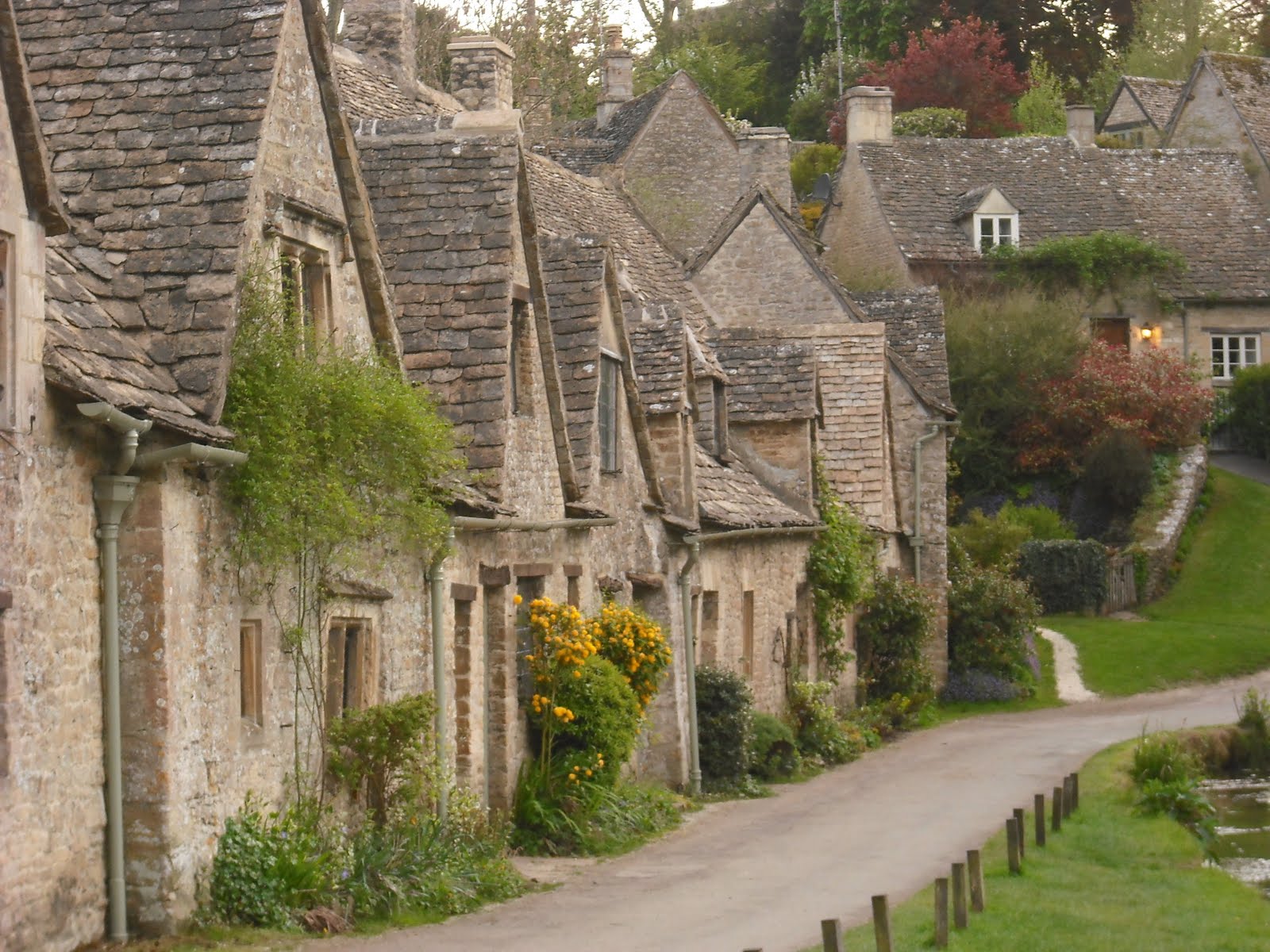
Nineteenth century writer and poet William Morris once described Bibury as “the most beautiful village in England.” It’s a view I find difficult to argue with.
Bibury is famous for Arlington Row, a row of medieval stone cottages. With their honey-colored stone and steep pitched roofs, they are among the most photographed images in Britain.
My dad moved to Bibury 10 years ago and visiting is always a treat. Situated in the Cotswolds, an area of gently rolling hills in the English countryside, Bibury exudes charm from every house and tree and meadow. Footpaths cross scenic hills and fields leading to rivers, woods, and charming country pubs. Life is unhurried and the past is ever present.
The village is popular with tourists from all over the world; they arrive in their hundreds on sunny summer days but also on the coldest winter day.
Arlington Row was built in 1380 as a monastic wool store and converted to the present day cottages in the 17th century. The cottages face out to a water meadow, known as Rack Isle, once used to dry the cloth for Arlington Mill on the other side, but now a wildlife preserve for water voles, frogs, and other animals. It takes its name from the wooden racks that were used to stretch the drying cloth.
There are some great places to eat and drink in the village, my favorite being the Catherine Wheel, which dates from the 15th century. But it‘s also fun to explore, and on many an occasion I'll drive through the countryside with my dad in search of country pubs further afield - and we have found a few.
A real treat is to get up early and walk along the River Coln, which runs through the village, and along Arlington Row as the first rays of sunlight kiss the limestone walls giving them a warm, luminous glow. Equally enjoyable is to walk the same route after dark when the stars in an ink blue sky sparkle above steeply-pitched slate roofs.
Spring is my favorite time to visit. Daffodils sway softly in fields filled with new-born lambs that skip joyfully up gentle inclines, their fresh white wool in sharp contrast to the lush green grass.
In summer I love to walk across the countryside. A favorite route is to the nearby village of Coln St. Aldwyns, a journey lasting roughly an hour. My dad and I once walked there together. We climbed over stone stiles, walked beside ancient dry stone walls, through woods and along pathways edged into the earth. We saw no people, just the occasional house in the distance, the golden-colored Cotswold stone blending into the land and the land into the sky.
In autumn, the smell of fallen leaves mixes with the rich clay earth. Smoke rises from cottage chimneys and fills the crisp air with the smell of burning wood.
In winter the light fades early. A walk at dusk along Water Lane, the narrow path that borders Rack Isle, reveals bare trees cloaked in the frozen embrace of frost.
A short walk from my dad’s house is the Saxon church of St. Mary. Tucked away in a tranquil setting the church dates from the 8th century, though Norman and Perpendicular styles can also be seen. The high, slender chancel arch is especially striking.
The entrance door is always unlocked so I often go inside, sit in one of the pews, and watch as rays of sunlight shine through the 13th century stained glass windows. I look at the plaques on the walls commemorating local men and the regiments they served. All left to fight for crown and country on foreign fields. None returned.
Outside in the churchyard, ancient gravestones covered in moss protrude through the earth. Next to the church is Bibury Court, a majestic Jacobean mansion, now a hotel, and set in six acres of grounds. The house itself was built in 1633 by the Sackville family, whose initials can still be seen carved over the entrance.
Access to Bibury Court is through a large wooden door set in an even larger stone wall that borders the churchyard. On the other side is an apple orchard, neatly clipped yew hedges, trees, arbors flanked by beds of lavender, vines and shrubs; meandering past on one side is the silvery river Coln.
It is the quintessential Englishness of Bibury that it so special. Even Hollywood used Arlington Row as part of the mythical village of 'Wall' in the 2007 film Stardust. I was visiting at the time as Bibury was transformed into a film set with bright lights, cameras, actors and...fake snow.
Other interest from this side of the Atlantic came in the form of Henry Ford who attempted to buy the cottages and ship them back to his home in Michigan. Fortunately the plan was blocked.
On a recent visit, long after the last tourist bus had departed, I stood on Swan Bridge, the river Coln flowing underneath. I watched as a silhouette of a white swan glided elegantly through the icy water; a black cousin followed closely behind. In the distance silhouetted against the darkening sky stood Arlington Row. Soft orange lights flickered through tiny windows in a scene both timeless and of its time.
Sunday, September 11, 2011
A Sanctuary in the City

The arrival of fall brings with it cooler temperatures and changing colors. It’s also the time of year when I look forward to harvesting the crops from my garden.
I live in a condo and don‘t have access to my own garden space at home, so having a plot at the Soo Line Community Garden is like having my own horticultural sanctuary in the city.
Nestled between Garfield and Harriet and bordered by the Greenway in South Minneapolis, the land was once the site of a grain elevator. After that was torn down in the late 1980s, it sat barren and stagnant in a state of tax forfeiture but has since been transformed and is today a destination for gardeners, cyclists, walkers and bird watchers.
The first plots were dug in 1992, and today there are close to a hundred. With the development of the Greenway, the land became very desirable and for years the specter of development loomed over gardeners’ carefully-nurtured plots.
But the custodians of the Soo Line, along with many residents, fought long and hard to secure the land for the gardeners of the future, finally seeing their efforts rewarded when administration of the site passed to the Park & Recreation Board in 2010 who subsequently granted approval for its permanent use as a community garden.
The surrounding neighborhood is very dense and many neighbors don’t have garden space of their own so the Soo Line also acts as a gathering point, and as somewhere for people to interact and to come together in a public space.
Next time you are nearby, or even if you find yourself walking or biking along the Greenway, take a moment and stop by. Walk through the garden and you’ll see many tiny miracles happening every day. In Spring--once the snow has melted--perhaps you’ll see just a few old leaves and last year’s perennials having emerged through winter’s frozen embrace; but wait a few weeks and you’ll be greeted by buds unfolding, leaves unfurling, and a sudden swirl of color.
Summer is my favorite time at the Soo Line. Long evening hours filled with scents from new flowers and many vibrant colors. My heart expands at the sight of day lilies and sunflowers swaying in the summer breeze, flowers and crops of many shapes and sizes, and at butterflies fluttering gracefully from one flower to another. I especially love to go there in the fading light, an hour or so before darkness. My garden also takes stock of my moods, as digging in the dirt is medicine for my soul.
September means longer shadows, shorter hours and petals that shrivel in the fall. Longer days of golden sun may have come and gone, but that also means that I’ll soon be enjoying many meals made from what I have grown.
Just last evening I returned from the garden with a bag filled with tomatoes, bell peppers, cherry peppers, rosemary, lima beans, tomatillos, and parsley. Likely I can leave my beets in the ground until well into October—the colder nights seem to enhance their flavor. And after that? I’ll just wait patiently until next spring - when rebirth comes again.
Monday, July 25, 2011
Developer's Plans Stir Debate in Small Community

I have often wondered about the impact of new housing and retail developments on older, established neighborhoods. How much input do residents have if opposed? Is compromise sometimes possible? Can developments be stopped?
I was recently prompted to ask these questions first-hand after learning of a proposal to build a five-story commercial/residential building in my community of Linden Hills in Minneapolis.
After reading about the project, known as Linden Corner, I attended a meeting of local residents opposed to the development and discovered that their views were broadly in line with my own; I also wanted to hear from the developer, Mark Dwyer, who lives in the area.
I contacted Dwyer and told him that although I was opposed to his plans, I would appreciate hearing his perspective and thoughts. He agreed to meet me.
Dwyer explained that what is being proposed is a five-story retail and residential development with plans to include approximately 34 condominiums, a restaurant, as well as a handful of businesses.
At present, the proposed site is zoned for buildings no taller than three stories in height and Dwyer is seeking a variance--or conditional use permit--to override this. Further, there’s an additional layer of regulations that was drawn up by local residents and businesses over a decade ago to protect the character and image of the area.
An affable man with a pleasant manner, Dwyer believes his plan makes economic sense for Linden Hills, in part due to the departure of the previous anchor tenant. He either owns the existing buildings at the proposed site (43rd and Upton) on a contract for deed, or has options to buy. But can he sell his plan to the community, I wondered.
Dwyer says he is sensitive to the aesthetic of Linden Hills but insists that five stories are necessary economically. “There is just a small group of people who are opposed,” he said.
My own observation differs drastically as I see a groundswell of opinion against his plans.
I asked how he might react if a petition (which I know to be circulating the area) were presented containing the signatures of a significant number of residents. “Opposition is important and healthy and informs opinion. We believe we are bringing the solution that has the best balance,” he said. “Change will happen in the face of opposition. It balances needs and wants. If there is an alternative that’s better, I’m not aware of one.”
I believe that the majority of people wouldn’t have an issue with a three-story structure. So why not build within the current zoning? “A three-story building isn’t a marketable property. Five stories drive the revenue, and it can’t be built smaller,” he replied.
This leads me to speculate that if scale and economy are linked, if this is the only way for the project to be financially viable, and if that doesn’t match what the community wants, then perhaps something somewhere is wrong.
If Dwyer is convinced this development will benefit the area, another resident, Kristin Tombers, owner of Clancey’s Meats, has a different point of view. She believes that the independent owner/operator businesses currently prevalent in the area reflect the “charming, small and village-like” feel of the business district.
“A large, cold commanding structure will be at extreme odds with the community’s current personality, no matter how thoughtfully or tastefully executed," she said.
“The beauty, charm and magic of Linden Hills will be lost for the people who love it here and the businesses of today will be gone forever to the commerce of the future. Whose future and well-being, then, are we talking about?”
Nor does Tombers view this project as inevitable and even has some creative alternatives for the corner. She alludes to the possible availability of grant money to make this an “urban green space” and “something innovative, inspiring, and responsible for all our interests, not just a select few.”
The developer’s website gives details of a local design team that has employed many features tailored to the aesthetics of the community, but I can’t get past the sheer size (both in height and length) that I feel is so wrong for the area. As someone said to me the other day, the reason Linden Hills has remained quaint and charming is because it is the total opposite of what this proposed development represents.
I think it is a false assumption to think that a small community will not be affected by a giant complex like this at its heart. I am also concerned about the types of businesses that will fill the retail spaces. Will they be national chains or will they be small locally-owned businesses? Linden Hills' pedestrian-friendliness would be overwhelmed by a development on this scale.
I appreciate the efforts made to reach out to the community, and I don't even mind the design, but for me the bottom line is the size of the project. It would tower over the area.
But if there is a Plan B, in the event that an override to the existing regulations cannot be obtained, I am sure many people in the community would love to have a voice in any future plans.
I love the small town feel of this community. It is unique, has character, and is unlike so many other places because of that. I am in favor of responsible development and believe the existing zoning should be respected. Overriding that would set a precedent for other developers wishing to build taller than permitted buildings in the area.
There are a lot of other issues associated with the Linden Corner development, and I have only covered some of them. Please check out the resources below for more information.
Finally, I'd like to point out that the opinions expressed in this article are my own. I state this only because I have spoken with other residents who share similar views.
Links:
Linden Hills Neighborhood Council
Developer's Website
Neighborhood Opposition Facebook Page
Neighborhood Opposition Website
Developer's Facebook Page
Sunday, June 12, 2011
Arab Spring

The popular revolts taking place across the Arab world came as a surprise, but big changes always do. Yet history shows us that repressive governments are not finite. Just look at the Soviet Union. Communism’s collapse once seemed unimaginable, too.
Like a set of dominoes waiting to be toppled, the old guard--the despots and the autocrats--many of whom have bled their societies dry, are on shaky ground. Freedom of expression is clearly a threat to their survival.
Ruled for too long by dictators who cared little for the wishes of their populations, the image of Arab peoples has gone through a rapid sea change that has seized the imagination of the world.
The popular image of the ubiquitous terrorist and the Arab “strongman,” where stability equaled stagnation, are being swept away. After all, what choice is there for men who have come to power by non-democratic means except to resort to force or flee?
The West paid lip service to alliances in the Middle East at the expense of the citizens of those countries. A stable Middle East was a synonym for many things, among them free-flowing oil.
With the fall of Mubarak in Egypt, American foreign policy was re-made overnight. As a consequence, the US isn’t in the driving seat anymore - the Arab people are. And you’d better believe the West is paying attention.
But it is the concept of dignity and taking justice into one’s own hands that I find particularly inspiring. I marvel at the courage of the people driving the changes. Shaking off decades of passivity must be intoxicating. And in an age where technology has made information both accessible and instant, Facebook and Twitter seem to have served as catalysts for the widespread eruption of rage, certainly among the young.
I recall hearing about a man in Egypt whose identity card was issued with an incorrect spelling (and hence a subsequent mispronunciation) of his name. Because of corruption and inefficiency he had to go through life constantly dealing with this slight. This might be a small thing to us in the West, but it’s so important a concept for an individual’s pride and dignity.
There is civil war in Libya and perhaps in Yemen and Syria, too. No one knows what the eventual government of Egypt might look like, and Islamist influence remains an unknown across the entire region; but I can't help but feel that extreme Islamist ideologies will continue to subside if popular revolutions drive real change.
Israel isn't immune from these shockwaves, either. Without Syrian support, Lebanon might also descend into chaos. Perhaps even the US might be less friendly toward Israel if she is seen as an obstacle to US influence in the new Middle East.
For Israel, supporting moves toward democracy in the Arab countries is a gamble because she needs stability and predictability. The Arab Spring could yet turn into an Israeli Winter.
What if the Palestinians again march to Israel’s borders but in greater numbers? Used to dealing with violent demonstrations, what would Israeli soldiers do when confronted with thousands of unarmed demonstrators demanding to return to homes their families lost over half a century ago?
Change does not necessarily mean the Arab people will remain anti-American in the long run and I think this is a real chance for the US to be an influential partner. Gone are the days of supporting dictators as the lesser of two evils. The Arabs have revolted by themselves. These are their revolutions. But freedoms won can turn into dictatorship again. Widespread violence cannot be ruled out. Western style democracy seems unlikely, but it is too early to know that.
It is for future historians to grapple with the significance of what is happening today. Will it be a transition to democracy, or a reshuffle to a different form of autocracy?
After all, despite the best efforts of NATO, Gaddafi is still in power, and President Assad--aided by his ghastly brother--will kill as many of his own citizens as is necessary to remain in power. Plus, if and when change comes to Saudi Arabia, expect bigger earthquakes ahead.
These are heady times and I hope the Arab Spring blossoms into real change and not something that might have been.
Subscribe to:
Posts (Atom)
A Fresh Beginning
After a long stretch of quiet here, it feels like the right moment to close this chapter of allinaword. The good news is that it’s not rea...
-
I have often wondered about the impact of new housing and retail developments on older, established neighborhoods. How much input do reside...
-
I didn’t grow up with guns. I have never owned a gun. In fact, as a child and young adult in Great Britain, I never even saw a gun - except...
-
I love technology--technology makes things convenient--but I wish technology had left the personal letter alone. Although it’s a long time s...